
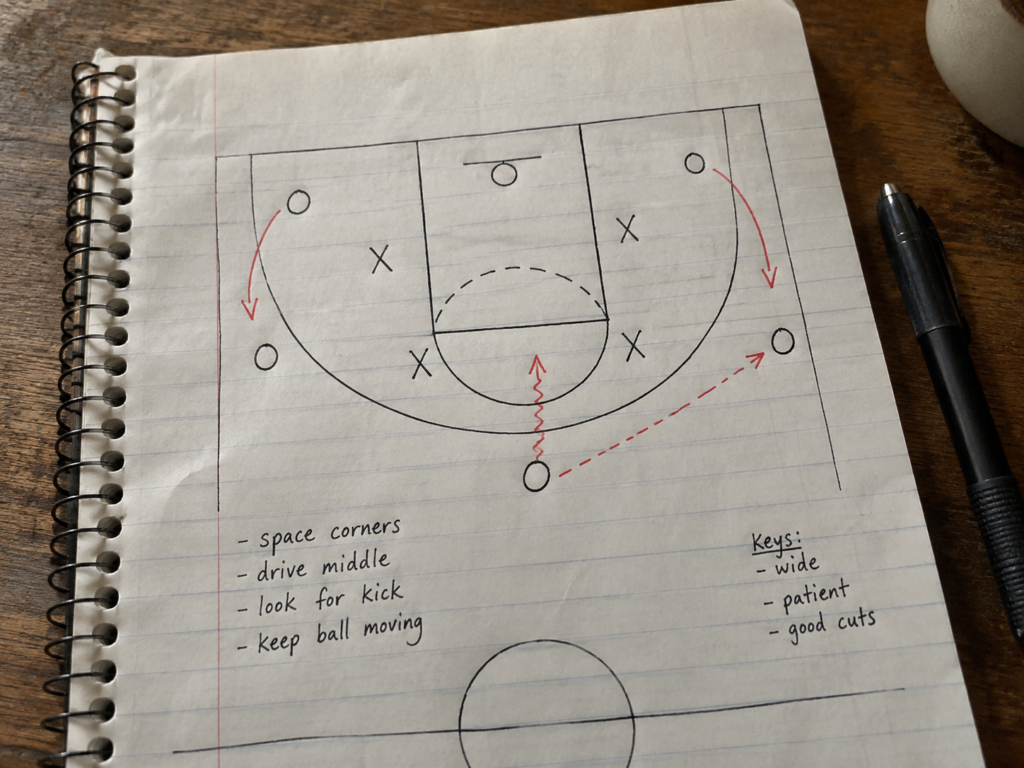
There’s a moment you see all the time in youth basketball.
A team comes down the floor. The point guard looks at the coach. The coach calls a play. Everyone runs to a spot.
Then something unexpected happens.
A defender denies the first pass. Someone switches. A teammate cuts at the wrong time. The ball ends up somewhere it wasn’t supposed to.
And suddenly, five players who looked incredibly organized three seconds earlier have no idea what to do.
That’s the difference between knowing a play and knowing how to play basketball.
At younger ages, those two things can easily get confused.
A team that runs five or six set plays, presses, traps and gets the ball into the hands of its best player every possession might win a lot of games.
It might also be developing fewer basketball players.
Former NBA head coach Stan Van Gundy once put the choice this way:
“You have to make a decision if you want to teach the kids how to play basketball or if you just want to win games.”
That doesn’t mean winning is bad. Kids should compete. Keeping score matters. Learning how to handle pressure, disappointment and close games is part of sports.
But winning should be evidence of development, not a substitute for it.
A play can solve the possession. Understanding solves the game.
Imagine a coach has a great baseline out-of-bounds play.
Player A screens for Player B. Player B cuts to the rim. Player C throws the pass.
Run it enough times and a young team might become excellent at executing it.
But what did the players actually learn?
Did Player B learn why the screen created separation?
Did Player A recognize how the defender was positioned before setting it?
Does Player C know that if the defender takes away the cut, somebody else may now be open?
Would any of the three recognize the same advantage in the middle of a completely different possession?
That’s the developmental question.
Canada Basketball’s coaching material states the philosophy plainly:
“We want to teach players how to play, not run plays.”
The idea is not to avoid structure. It is to build skills and concepts first so players can eventually function inside any system, instead of becoming dependent on one.
Because basketball is not choreography.
The defence gets a vote.
The best players eventually have to solve problems themselves.
Watch a good basketball possession at almost any advanced level.
A coach may have called an action. The team may have an offensive structure. But within seconds, the possession becomes a series of decisions.
The defender goes under the screen. Do you shoot?
They switch. Do you attack the mismatch?
Help comes early. Do you make the pass?
Your defender overplays the wing. Do you back-cut?
A teammate drives toward you. Do you stand there—or create space?
Those decisions are basketball.
The Jr. NBA has deliberately pushed its youth curriculum further in this direction, adding more small-sided games, unpredictable starts and activities designed to develop decision-making instead of having every repetition begin from a predetermined position.
USA Basketball makes a similar point through 3×3, where fewer players on the floor means more touches, more reads and more repeated decisions.
If every drill tells a child exactly where to go, when to go there and what to do when they arrive, we shouldn’t be surprised when they struggle the moment nobody tells them.
Sometimes the fastest way to win is not the best way to develop.
This is where youth coaching gets difficult.
There are strategies that work extremely well against young players precisely because young players are still developing.
Pack the paint because 10-year-olds cannot consistently shoot from distance.
Press the entire game because young players struggle handling pressure.
Keep the ball in one advanced guard’s hands because they can beat almost everyone one-on-one.
Put the tallest child under the basket and tell them never to dribble.
You may win.
But what happens three years later?
The guard hasn’t learned to play without the ball.
The big hasn’t learned to handle it.
The other three players haven’t made enough decisions with it.
And a defensive strategy that overwhelmed children no longer overwhelms bigger, stronger and more skilled teenagers.
The NBA and USA Basketball’s youth guidelines explicitly warn against an overemphasis on early competitive success and call for age- and stage-appropriate skill development.
Miami Heat head coach Erik Spoelstra has made the same point about long-term development:
“Winning can not be the number one priority.”
That line is easy to misunderstand.
It doesn’t say don’t try to win.
It says don’t sacrifice what a player could become at 16 because you desperately want to beat another group of 10-year-olds today.
So what should young players learn instead?
They need structure.
Just a different kind of structure.
Instead of memorizing ten possessions, teach concepts they will encounter thousands of times.
Create space.
Don’t bring your defender to the ball.
Cut with a purpose.
If you’re denied, can you go backdoor?
Move after you pass.
Don’t become a spectator because the ball left your hands.
Attack an advantage.
If you beat your defender, go somewhere.
Recognize help.
If a second defender stops you, somebody became open.
Play under control.
Arrive balanced enough to see the floor and make the next decision.
Learn every position.
Young tall players should handle the ball. Guards should learn to screen. Everyone should pass, defend and rebound.
This is one reason small-sided basketball can be so valuable. In 2-on-2 and 3-on-3, there is nowhere to hide. Every player has to touch the ball, defend, space, cut and make decisions.
And this is an important distinction:
Less scripting does not mean less coaching.
It usually requires more.
It’s easy to say, “Run Play 4.”
It is harder to stop a possession and ask:
What did you see?
Where was the help defender?
Why did that cut work?
What could you have done when they denied you?
Now the player has to think.
Plays aren’t the enemy.
A good youth team can absolutely run plays.
An out-of-bounds set makes sense.
A simple press break makes sense.
A basic motion action, ball screen or entry can teach spacing and movement.
And as players get older, tactical sophistication should increase.
The problem starts when memorizing the pattern becomes more important than understanding the problem the pattern was designed to solve.
A play should introduce an idea.
Then players should learn to recognize that idea when the play disappears.
If we run a give-and-go, eventually the lesson shouldn’t be:
“Pass to the wing, then cut.”
It should become:
“When I pass and my defender turns their head, there may be space behind them.”
That travels with the player.
To another team.
Another coach.
Another system.
Another level.
What are we actually trying to produce?
This is probably the most important question.
At the end of a youth season, is success that a team knows twelve plays?
Or that twelve players understand basketball a little better than they did in September?
Can they dribble with either hand?
Can they play through pressure?
Can they finish?
Can they see a teammate?
Can they recognize space?
Can they defend without being hidden in a scheme?
Can they make a mistake, understand it and make a different decision the next possession?
The Jr. NBA’s coaching guidance puts the priority clearly:
“Wins and losses come and go, but you only get one chance to develop a player’s skills.”
That’s the standard we believe in at North City Bruins.
We want to compete.
We want players to care about winning.
We want close games, hard possessions and moments that matter.
But when our players eventually leave us, the goal isn’t for them to remember where Coach told them to stand in a play they ran when they were ten.
The goal is for them to step onto a basketball court, look around—and know how to play.
Further reading: Canada Basketball — Coaching in Competition; Jr. NBA Instructional Curriculum; NBA & USA Basketball Youth Guidelines; Miami Heat — The Kids Game; Jr. NBA Coach’s Code of Conduct; Stan Van Gundy on youth basketball skill development.